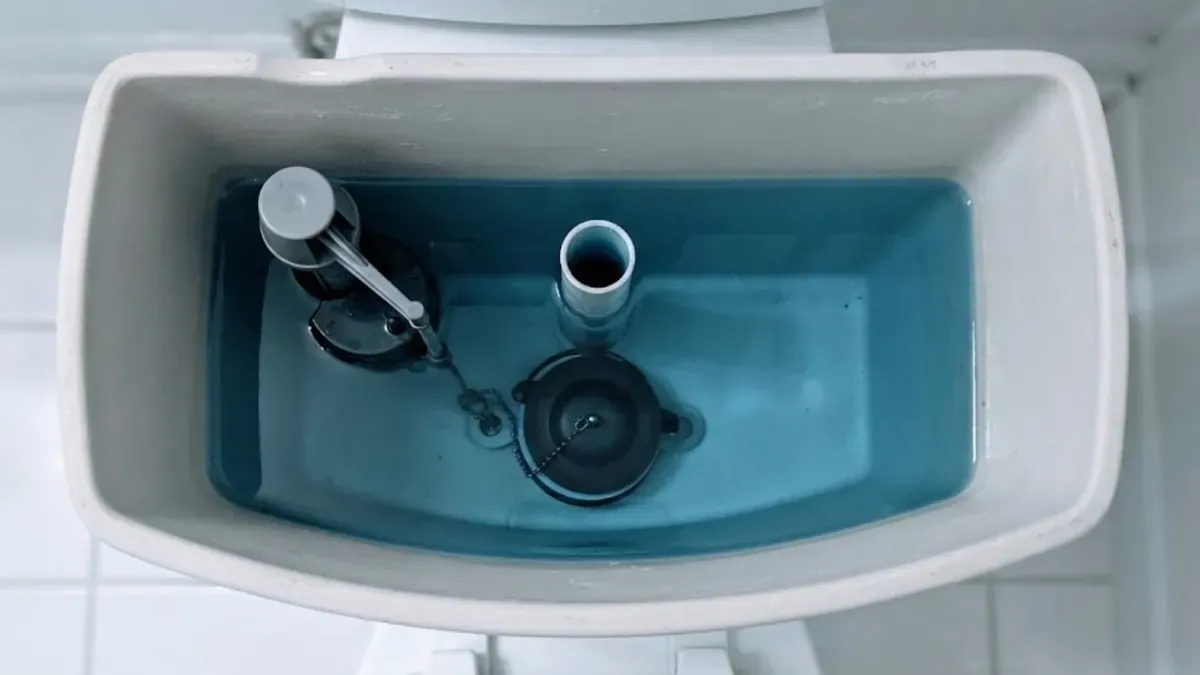
How a toilet tank works
When you flush, the flapper at the bottom of the tank lifts and water rushes into the bowl. The flapper drops back down to seal the tank, and the fill valve refills the tank until a float tells it to stop. An overflow tube sits in the middle as a safety, sending extra water down the drain if the fill valve fails.
A toilet runs when one of these parts is not doing its job. Finding which one is a matter of watching and testing.
Symptoms and likely causes
Match what you hear to the likely part.
| What you notice | Likely cause | Typical fix |
|---|---|---|
| Runs every few minutes with no flush | Leaking flapper | Replace the flapper |
| Water runs into the overflow tube | Fill valve or float set too high | Adjust or replace the fill valve |
| Hissing as the tank fills | Worn fill valve | Replace the fill valve |
| Handle sticks or chain is tangled | Chain too long or too short | Adjust the chain |
| Runs after the flush for a long time | Flapper not seating | Clean the seat or replace the flapper |
The dye test
Remove the tank lid and add a few drops of food coloring to the tank. Do not flush. Wait about 15 minutes. If color shows up in the bowl, the flapper is leaking, since only a leaking flapper lets tank water pass. If the bowl stays clear but water still runs, look at the fill valve and the water level.
Check the water level
The water should sit about an inch below the top of the overflow tube. If it is higher, water spills into the tube and the toilet runs. Adjusting the float, usually with a screw or a clip on the fill valve, lowers the level. If adjusting does nothing, the fill valve itself is worn.
Dealing with this right now? Call the line and describe what is happening.
Call (407) 964-8940Replacing a flapper
A flapper swap takes about 15 minutes.
- Close the supply valve. Turn the oval handle at the wall clockwise.
- Flush to empty the tank. Hold the handle down.
- Unhook the old flapper. Detach the chain and slide the flapper off its pegs.
- Install the new one. Match the style and size, and set the chain with a little slack.
- Open the valve and test. Run the dye test again.
Replacing a fill valve
A fill valve replacement is also a home-friendly job for many people, but it involves removing the supply line and a nut under the tank. If the connection looks corroded or the shutoff valve will not hold, stop and call a plumber. Our toilet repair page describes what we handle.
What a silent leak costs
A toilet that leaks silently can waste a lot of water over a month, and you may not hear it. If your bill rises without explanation, run the dye test on every toilet in the house. If the toilets are fine and the meter still moves with everything off, see leak detection.
Chain, float and handle problems
A chain that is too tight holds the flapper open, and one that is too loose can slip under it and block the seal. The chain should have about half an inch of slack. A float that rubs against the tank wall can also keep the fill valve on. Bend the float arm gently or adjust the clip so it moves freely. A sticky handle may only need cleaning of the lever arm.
When the toilet is old
A toilet more than twenty years old may have parts that are no longer sold, and its tank can have a worn seat that no flapper seals. Repairs there can cost more than they are worth. Replacing the toilet with a modern efficient model fixes the leak and lowers water use. A plumber can compare the two options for you.
Water use and your bill in Apopka
The City of Apopka's website has pages for utility billing and for paying your bill online, which is the place to check usage if you suspect a leak. A running toilet is one of the easiest causes to fix once you find it.
For repairs that involve the supply line or shutoff valve, ask your plumber what is typical. For larger remodeling work, ask the City of Apopka building division whether a permit applies.
Plumbers in Ocoee and Altamonte Springs use the same steps, and so do we when we visit.
Standards and sources. Fixture repairs follow the manufacturer's instructions and the Florida Building Code, Plumbing. The EPA's WaterSense program labels toilets that use 1.28 gallons per flush or less, which is a useful standard to look for when you replace one.
Running toilet questions from Apopka homeowners
A lot over a month. Even a slow leak can add up, and a silent one is easy to miss.
Run the dye test. Color in the bowl points to the flapper.
Many people can replace a flapper, and a plumber is better for a stuck shutoff valve or a corroded supply line.
A small leak can be audible only when the house is quiet.
Start with the City of Apopka's utility billing page.
Want a plumber to look at it? Call the line and describe what you see.
Call (407) 964-8940